The Ultimate 2026 CPU Cooling Showdown: AIO Liquid Cooling vs. Air Cooling
As next-generation high-end processors—such as the AMD Ryzen 9000 / 7000 X3D series and Intel's flagship processors—continue to scale up their processing power, CPU "thermal density" has reached historic highs. When building a new system, many gamers and power users find themselves at a crossroads: "Should I stick with a traditional dual-tower air cooler, or upgrade to an All-in-One (AIO) liquid cooler?"
What exactly makes an AIO liquid cooler superior to traditional air cooling under modern workloads? And how has ASRock engineered its newest AIO lineup to tame the extreme heat of modern CPUs? This guide will break down the crucial differences and dissect ASRock's 7 hardcore cooling technologies.
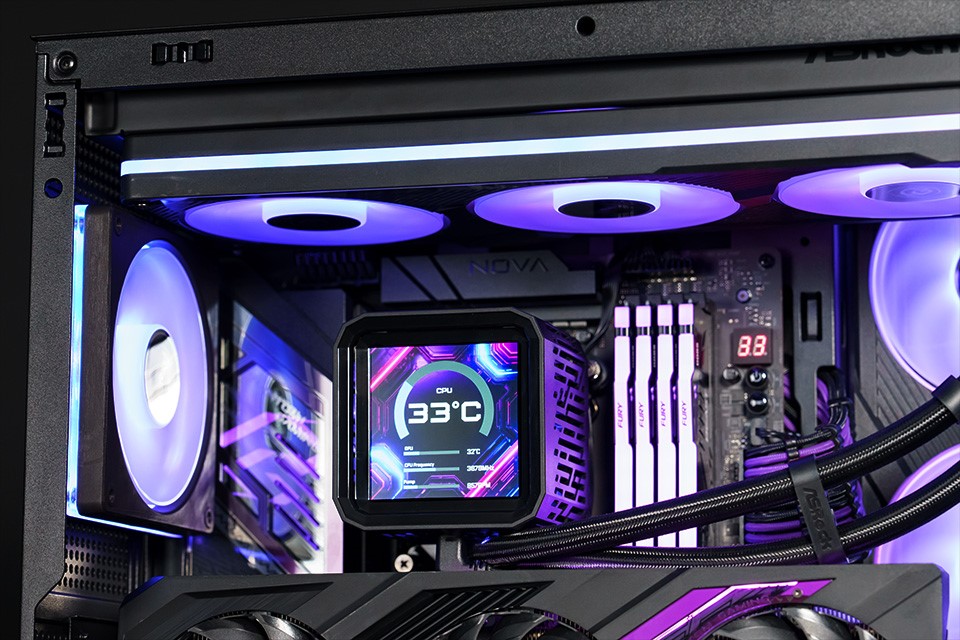
Flagship AIO build concept: a large high-resolution LCD panel provides real-time monitoring, while the compact water block leaves tall RGB memory and the motherboard power area completely unobstructed—performance and gaming aesthetics in one.
I. AIO Liquid Cooling vs. Traditional Air Cooling: The Four Core Advantages
Before selecting your thermal solution, let us examine the real-world benefits of upgrading to an AIO liquid cooler compared to a traditional dual-tower air cooler:
Comparison Metric | Traditional Air Cooler (Dual-Tower) | AIO Liquid Cooler (360mm Example) | The AIO Core Advantage |
Max Heat Dissipation Limit (TDP) | Approx. 220W - 250W | 300W - 350W+ | Tames Instantaneous Temperature Spikes: Prevents high-end CPUs from throttling or hitting temperature walls during full-core, heavy-duty workloads. |
Noise Under High Load | Fan blades must run at 100% speed, creating noticeable wind shear noise | Coolant absorbs heat as a buffer; fans run at stable, moderate speeds | Whisper-Quiet Operation: Liquid coolant has a higher specific heat capacity, smoothing out sudden thermal peaks so fans don't constantly ramp up and down aggressively. |
Motherboard & RAM Compatibility | Massive metal heatsinks often overhang or block high-end RGB memory modules | Only the water block mounts on the CPU socket, leaving ample clearance | 100% Zero Interference: Showcases motherboard aesthetics and easily accommodates tall, premium RGB RAM modules without any clearance issues. |
Chassis Airflow & Heat Cycle | Dissipates hot air inside the case, heavily taxing the chassis exhaust system | Expels heat directly out of the chassis via the radiator exhaust | Lower System Ambient Temp: Prevents CPU exhaust from heating up nearby high-end graphics cards and M.2 SSDs. |
II. The Thermal Pain Points of Modern Flagship CPUs: Why Air Cooling is Reaching Its Limits
Modern high-performance CPUs utilize cutting-edge manufacturing processes and chiplet architectures. While this yields incredible performance gains, it presents two unprecedented cooling challenges:
• Shrinking Die Area & Extreme Thermal Density (Hotspots): Huge thermal output is concentrated in a microscopic area. The heat transfer rate of traditional pure copper heat pipes can no longer keep pace with the instantaneous heat generated by dense processing nodes.
• Aggressive Dynamic Boost Mechanisms: Modern CPUs will instantly boost clock speeds and power consumption to the limit whenever there is thermal headroom. If the cooling system lacks sufficient heat-buffering capacity, the CPU will rapidly spike to 90°C or 95°C and immediately throttle, sacrificing valuable performance.
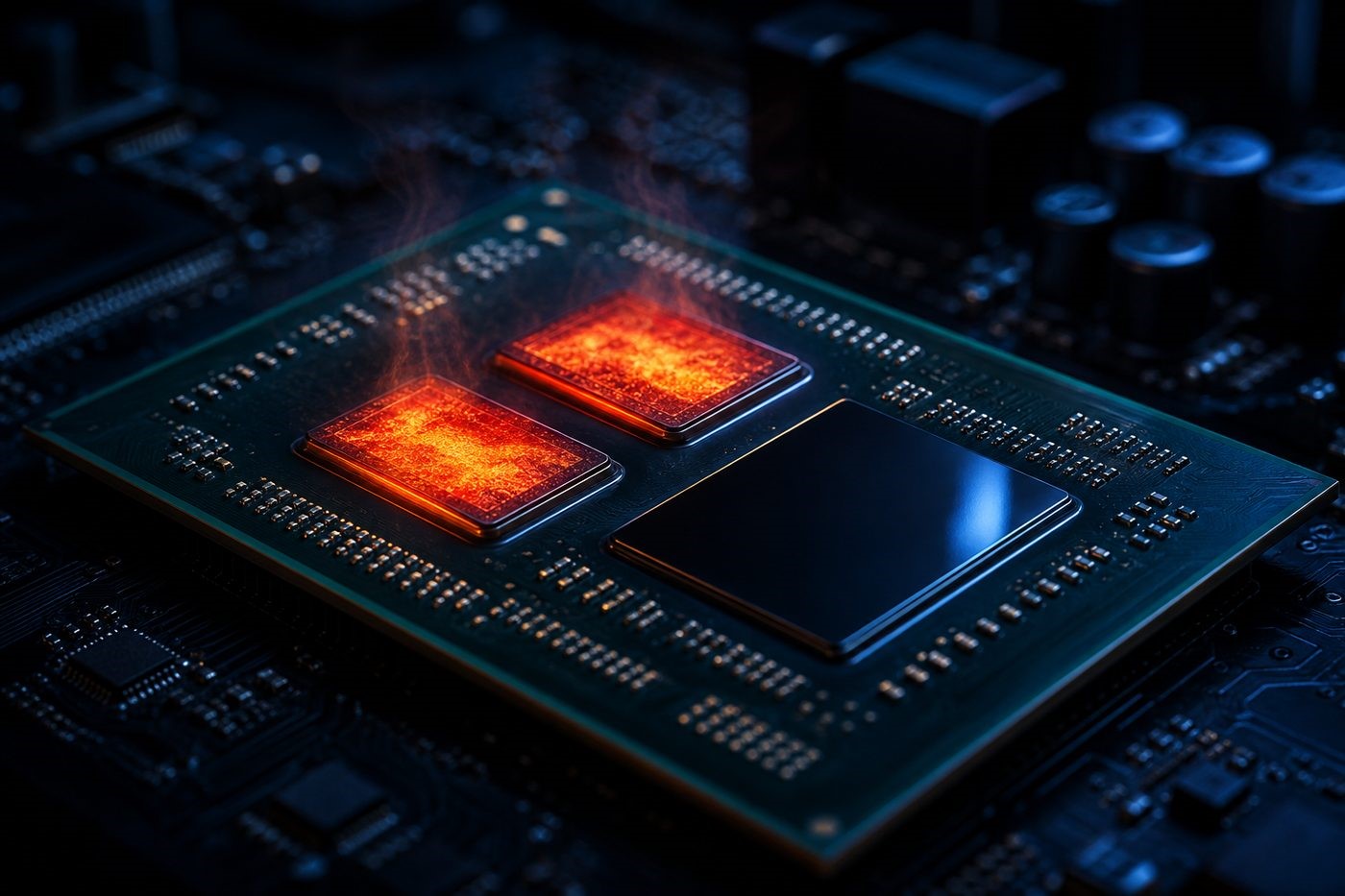
Thermal density concept: chiplet architectures concentrate massive power draw into tiny die areas, creating localized hotspots—exactly where traditional heat pipes start to fall behind.
III. Defeating the Hotspots: ASRock's 7 Hardcore AIO Liquid Cooling Specs
To combat these extreme thermal challenges, ASRock's AIO liquid cooling lineup incorporates seven key hardware specifications engineered to solve the modern gamer's thermal bottlenecks:
SPEC 01|Three-Phase Motor Design: Unleashing Torrential Flow Rates
• Technical Advantage: Employs a premium three-phase motor structure which delivers smoother, more powerful operational torque than traditional single-phase motors.
• The Solution: Dramatically boosts coolant pressure and circulation speed. It swiftly carries heat away from CPU hotspots and prevents heat accumulation within the microchannels.
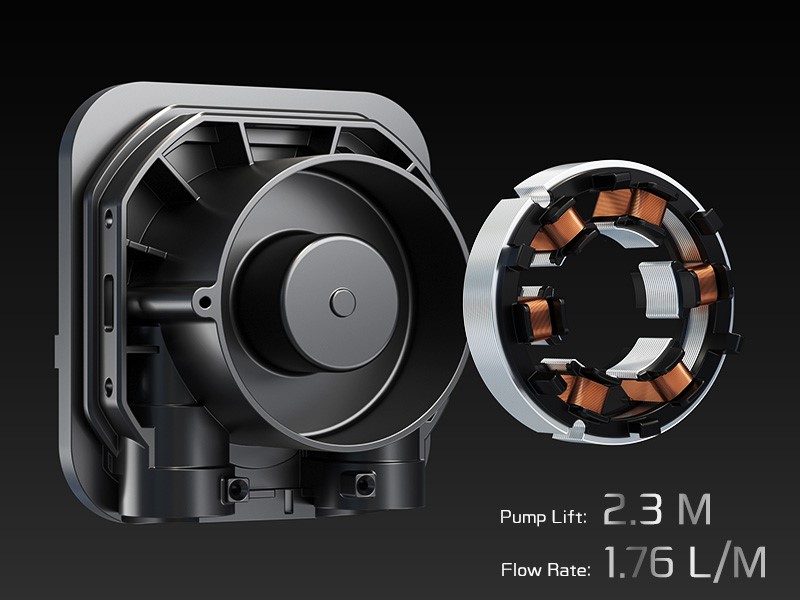
Pump cutaway concept: a three-phase motor drives the impeller at high speed, using greater head pressure and flow to sweep hotspot heat out of the microchannels instantly.
SPEC 02|Thick Radiator Design: Maximizing Thermal Capacity
• Technical Advantage: Rejects industry compromises by utilizing an extra-thick radiator design, which vastly increases the internal coolant volume and surface area of the cooling fins.
• The Solution: The increased coolant capacity provides a massive "thermal buffer." Whether you are running a long 3D rendering job or a marathon gaming session, it ensures the system never suffers from heat saturation.
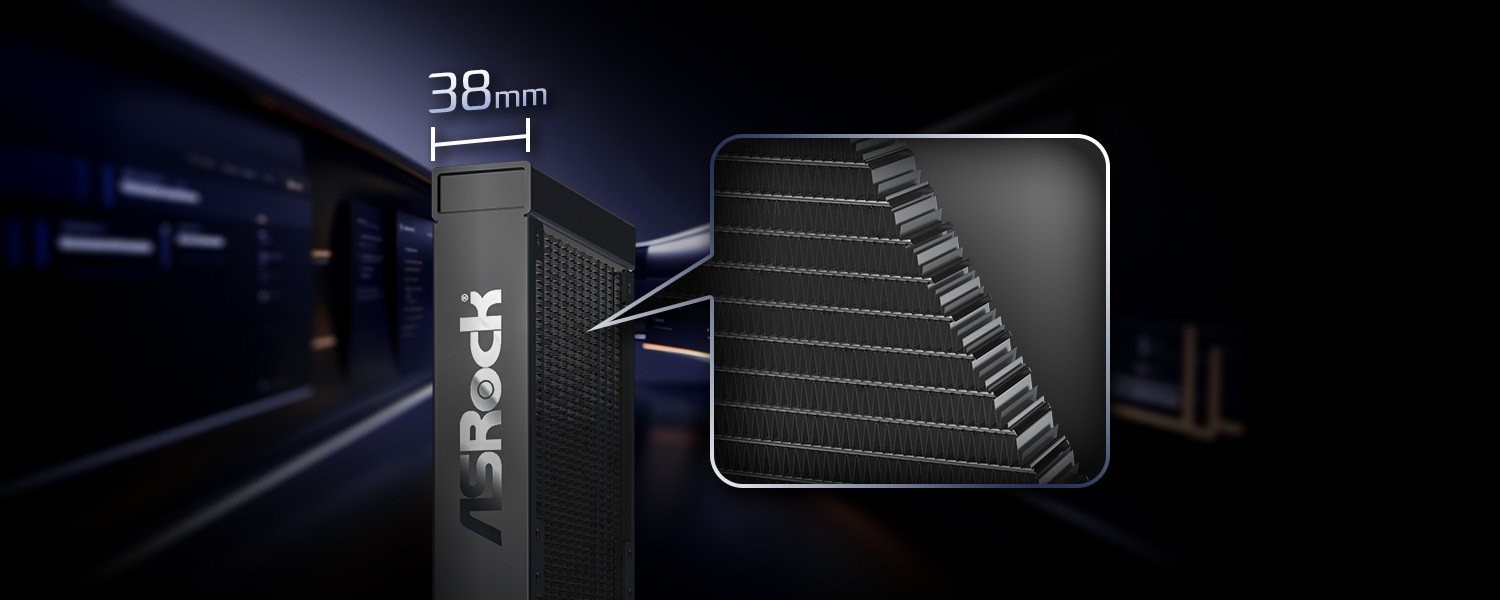
Thick radiator concept: a deeper core means more coolant volume and fin area—effectively a huge thermal buffer for the whole system.
SPEC 03|High-Static Pressure LCP Fans & FDB Bearings: Storm-Force Airflow, Whisper-Quiet Operation
• Technical Advantage: To blow through high-density thick radiators, ASRock uses fan blades constructed from LCP (Liquid Crystal Polymer). LCP offers extreme rigidity, ensuring blades never distort even at high RPMs. This is paired with high-end FDB (Fluid Dynamic Bearings) for ultra-low operational friction.
• The Solution: Delivers powerful, highly focused static pressure directly through the radiator fins, while eliminating high-speed resonance and motor noise.
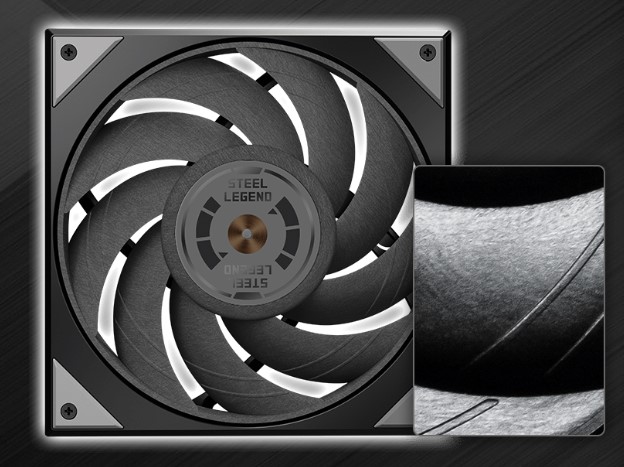
Key cooling tech concept: rigid LCP fan blades deliver extreme static pressure straight through the dense fins of the thick radiator, maximizing liquid-to-air heat exchange.
SPEC 04|High-Performance Therm-X1 Thermal Paste: The Ultimate Thermal Bridge
• Technical Advantage: The final millimeter of the thermal interface is the most critical. ASRock bundles premium ThermX1 thermal paste, which features outstanding thermal conductivity.
• The Solution: Perfectly fills microscopic air gaps between the CPU Integrated Heat Spreader (IHS) and the water block's pure copper base, lowering thermal resistance to the absolute minimum and unlocking 100% of the cooler's potential.
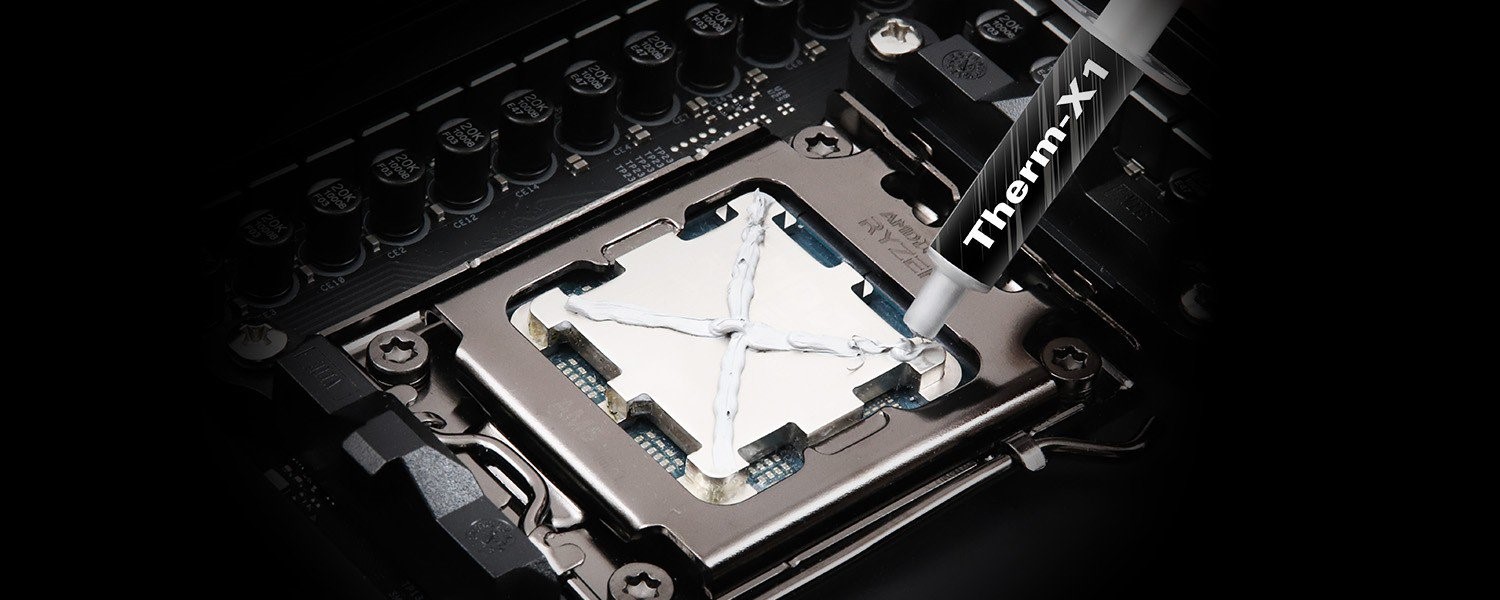
Thermal interface concept: paste fills the microscopic gaps between the CPU heat spreader and the pure copper base, minimizing thermal resistance across the final link of the chain.
SPEC 05|Dual-Flow Path Design: Ending Multi-Die Thermal Blind Spots
• Technical Advantage: Optimized internal water block microchannels featuring a revolutionary dual-flow path design, allowing coolant to pass over the large copper base more evenly and rapidly.
• The Solution: Specially engineered for modern Multi-Chip Module (MCM) processors (such as dual-CCD designs), this eliminates cooling blind spots and guarantees that all processing dies are chilled uniformly.
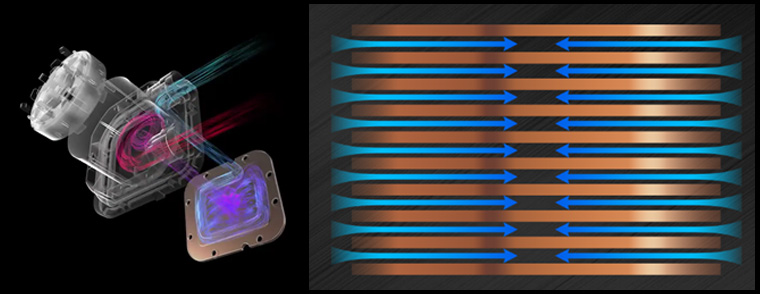
Dual-flow concept: two symmetric coolant streams sweep the entire micro-finned copper base, covering every scattered die evenly with no blind spots.
SPEC 06|Large LCD Real-Time Monitoring Panel: Your Personal Custom Stage
• Technical Advantage: The water block is capped with a large, high-resolution LCD screen, fully supporting hardware data feeds and customizable graphics playback.
• The Solution: Monitor CPU temperature, frequencies, and loads in real-time right from your hardware, eliminating resource-heavy software on-screen displays (OSD) while enabling custom GIF animations to match your personal build theme.
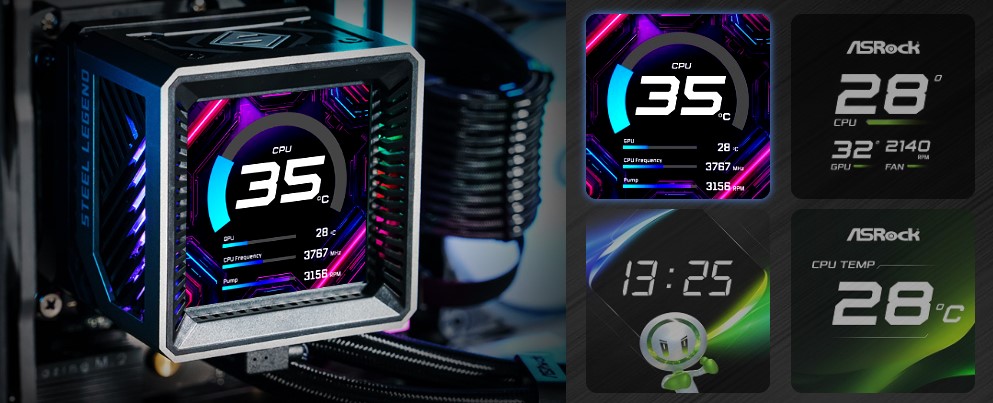
LCD block concept: the large screen renders monitoring data and custom animations directly on the hardware, with zero system overhead.
SPEC 07|Specialized VRM Cooling Module: Banishing the Liquid Cooling Blind Spot
• Technical Advantage: Integrates an active downward-draft micro-fan directly into the water block assembly, specifically targeted at the motherboard VRM area.
• The Solution: Traditional liquid coolers eliminate the ambient airflow that air coolers naturally blow over the motherboard. By adding an integrated VRM cooling module, ASRock drastically lowers power delivery temperatures, guaranteeing absolute stability during heavy overclocks.
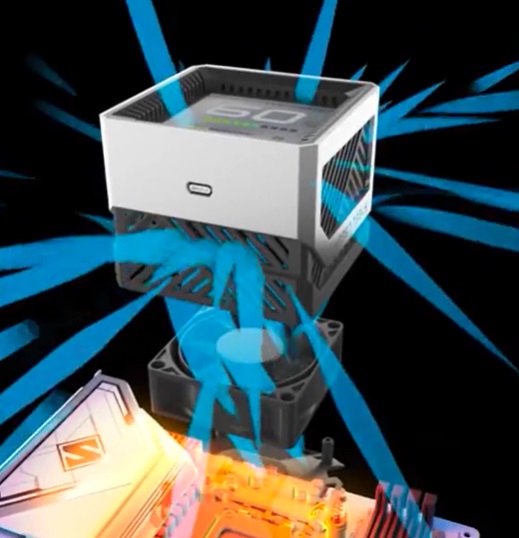
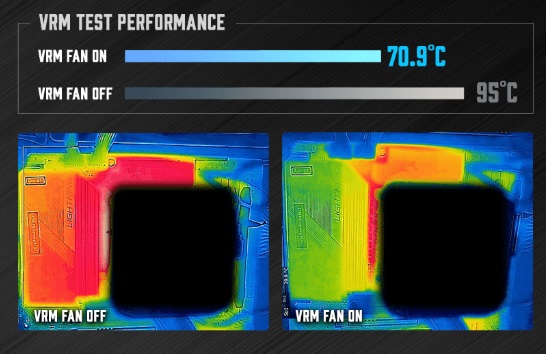
VRM cooling concept: a downward-draft micro-fan on the block actively sweeps air over the power-delivery components, closing liquid cooling's only airflow gap.
IV. Gamer FAQ
Q1: Will an AIO liquid cooler make my motherboard VRM run hotter than an air cooler?
This is a classic weakness of traditional liquid coolers, but ASRock has solved it. Thanks to the integrated active VRM Cooling Module on the water block, a dedicated fan actively pushes air over the motherboard power delivery phases. It not only matches but often outperforms traditional air-cooler airflow, handling even the most extreme overclocking loads.
Q2: If I only play games, do I really need a thick-radiator AIO?
We highly recommend it. Modern AAA games place immense instantaneous boost demands on the CPU. Utilizing an ASRock AIO equipped with a thick radiator and a three-phase motor ensures your frame rates (FPS) remain rock-solid without micro-stutters, while letting the high-performance LCP fans run at whisper-quiet RPMs.
Q3: Is it difficult to configure the large LCD screen?
It is extremely simple and intuitive. Simply connect the water block to an open USB header on your motherboard. Through ASRock's dedicated software, you can apply monitoring dashboards with a single click or drag-and-drop your favorite GIFs to easily customize your gaming rig.
V. Verdict: Which Cooler Should You Choose in 2026?
Choose ASRock AIO Liquid CoolingIf you are running a high-end CPU (such as Ryzen 9000/7000 X3D or Intel's flagship lineup), demand maximum CPU performance without thermal throttling, love high-end RGB RAM aesthetics, or want a whisper-quiet, highly personalized premium PC build. | Choose Traditional Air CoolingIf you are building a mid-range system, on a strict budget, or prefer a simple "set-and-forget" thermal solution with zero maintenance. |
Ready to unleash ultimate cooling performance in your next gaming build? Pick the ASRock AIO liquid cooler that fits your system and set your processor free!